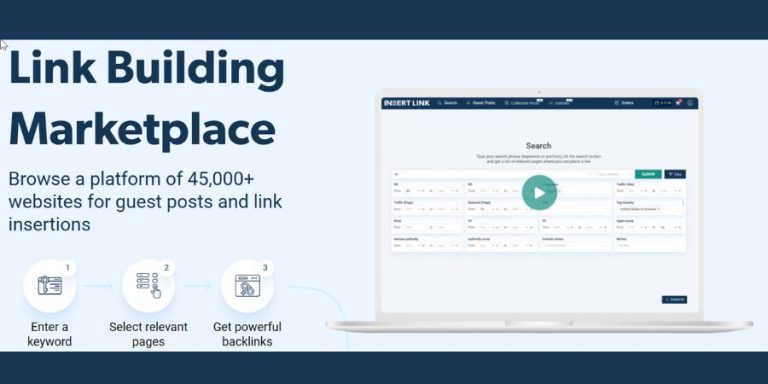
Insert.Link positions itself as a link-building marketplace focused mainly on two deliverables: link insertions (often called “niche edits”) and guest posts. The promise is straightforward: instead of doing manual outreach, chasing replies, negotiating prices, and managing endless spreadsheets, you search a database of websites/pages, choose placements, and place orders through one dashboard.
What the platform is (and what it isn’t)
Insert.Link is not an “SEO magic button.” It’s closer to a marketplace plus a workflow system that helps you purchase placements on partner sites—either inserting a link into an existing article or publishing a new article (guest post) with your link included.
They market a large inventory and broad coverage (many websites, countries/locations, and niches). That’s appealing, especially for agencies or marketers who need to scale link acquisition without hiring a dedicated outreach team.
Link insertion vs guest posts (why it matters)
Understanding the two main services is crucial:
- Link insertion / niche edit: Your link is added to an existing page. This page may already have age, indexing history, and sometimes existing backlinks and traffic. In many cases, this can look more “natural” than publishing a brand-new guest post, because the content already exists and the link is simply incorporated into it.
- Guest post: A new article is written and published on a site, typically including your link in the body.
Each method has its own pros and risks. Niche edits can sometimes deliver faster results because the page is already live, but they can also be riskier if the seller’s network contains sites that exist mainly to sell links. Guest posts offer more control over the content, but the new page may not rank or get traffic unless the site is strong and the post is genuinely useful.
How the process typically works
The general user flow (based on how the platform describes itself) is:
- Enter a keyword and use filters (country/language/niche, and sometimes page-level relevance filters).
- Browse pages that match your topic.
- Provide your URL and anchor text, then submit an order.
For agencies, Insert.Link also emphasizes “white label” options, reporting/invoicing convenience, and team/project workflows. In practice, that means you can organize orders for multiple client projects and keep everything tracked in one place.
Pricing model: what you should expect
Insert.Link appears to operate with a mixed pricing structure:
- Subscription/tool access (for using the platform, searches, and features depending on plan)
- Per-placement costs for link insertions and guest posts
A key point that matters: subscriptions are commonly treated as non-refundable once access is delivered. In other words, if you pay for a month and then decide it’s not for you, you should assume you may not get that subscription fee back.
For placements, there are often rules about what counts as “completed,” what happens if a link disappears early, and what qualifies for a refund or partial refund. Marketplaces frequently use a “verification window” (for example, a few business days) where you must check the placement and report issues, otherwise the order may be considered accepted.
Practical takeaway: if you buy placements, set a routine so you verify each delivered link quickly—URL, anchor text, placement context, and whether it’s visible to normal users.
The “white-hat” and compliance question (be realistic)
Insert.Link marketing language may suggest that niche edits can be “safe” or “compliant.” Here’s the honest truth: the safety of paid links depends heavily on how the links are placed and labeled, and on the quality and editorial standards of the sites involved.
Google has long discouraged buying/selling links that pass ranking value. Paid links are generally expected to be properly qualified (for example using sponsored/nofollow attributes). That doesn’t mean “everyone who buys a link gets punished,” but it does mean there is inherent policy risk if you build rankings primarily through paid placements.
The most realistic approach is to treat Insert.Link as one tool in a broader strategy, not the whole strategy. Use it carefully, avoid spammy patterns, and stay focused on relevance and natural link profiles.
Quality control: the biggest make-or-break factor
Every marketplace has the same core challenge: inventory quality varies.
Even if a platform shows SEO metrics (DR/DA, traffic estimates, keywords, referring domains, etc.), you should not blindly trust those numbers. Metrics can be inflated, traffic can be irrelevant, and some sites can be part of networks built mainly for selling links. The right move is to evaluate each opportunity like you’re buying media placement:
- Does the site look real and maintained?
- Does it have genuine topical focus?
- Do articles read like they’re written for humans?
- Are there obvious footprints of “SEO posts only”?
- Is the specific page relevant to your target page and your anchor text?
- Would you be comfortable if a competitor or customer saw that link?
If you can answer “yes” consistently, you’ll get far more value from the platform.
What results you should realistically expect
Buying links does not guarantee rankings. At best, strong placements can contribute to:
- improved authority signals to certain pages,
- better crawling/discovery of content,
- occasional referral traffic if the site has real readership,
- incremental ranking improvements over time.
At worst, low-quality placements can do nothing—or create risk, especially if your backlink profile becomes dominated by obvious paid placements, repetitive anchors, or irrelevant sites.
A healthy mindset is: measure performance like a marketer, not a gambler.
Track:
- ranking movement for targeted pages,
- Search Console impressions/clicks,
- referral traffic,
- indexing stability,
- link persistence over time.
Customer experience and operations
Most link marketplaces live or die on operations:
- speed of delivery,
- support responsiveness,
- handling of replacements if a publisher refuses or removes links,
- clarity in dispute resolution.
If Insert.Link provides a clear acceptance window and documented rules for replacements/refunds, that’s a positive sign because it reduces ambiguity. Still, you should expect that some placements can fail (publisher changes mind, page is edited, link removed later, etc.). That’s normal in this industry.
Who this is best for
Insert.Link is most suitable for:
- Agencies that need to scale link acquisition across multiple clients.
- In-house SEO teams with a defined process and budget.
- Experienced marketers who know how to evaluate sites and manage risk.
It’s especially useful if you value speed and you want to avoid the heavy labor of outreach.
Who should be cautious (or avoid)
- Beginners who believe links alone will “fix SEO.”
- Brands in sensitive niches (health, finance, legal, major brand reputation environments) where risk tolerance is very low.
- Anyone who wants a “guaranteed ranking lift.” No legitimate service can promise that safely.
Pros
- Saves a lot of time compared to manual outreach.
- Centralized dashboard for searching, ordering, and tracking placements.
- Potentially broad inventory across many niches and regions.
- Good fit for agencies if it supports reporting and multi-project workflows.
Cons / Risks
- Inventory quality can vary widely (you must vet placements).
- Policy risk exists if links are paid and pass ranking value without proper disclosure/attributes.
- Subscription fees are often non-refundable once access is provided.
- Real ROI depends heavily on your niche, your site quality, your content, and your selection discipline.
Final verdict
Insert.Link appears to be a practical marketplace for marketers who want a faster path to link placements via niche edits and guest posts. The value isn’t only in the links—it’s in the workflow and time saved. However, the platform is only as good as the quality of the sites you choose and the discipline of your SEO strategy.
If you approach it with controlled testing, careful vetting, conservative anchor strategy, and realistic expectations, it can be a useful part of your SEO toolkit. If you treat it as a shortcut where you buy a bunch of links and expect guaranteed rankings, you’ll likely waste money—and potentially create risk.